
1207 stories
·
0 followers

Omissions, Deceptions, Lying. The New Yorker Asks: Can Sam Altman Be Trusted?

1 Share
A 17,000-word expose in the New Yorker reveals "several executives connected to OpenAI have expressed ongoing reservations about Altman's leadership." Reporters Ronan Farrow and Andrew Marantz spoke to "a hundred people with firsthand knowledge of how Altman conducts business," including current and former OpenAI employees and board members. Among other revelations, internal messages from a few years ago show that OpenAI executives and board members "had come to believe that Altman's omissions and deceptions might have ramifications for the safety of OpenAI's products..." At the behest of his fellow board members, [OpenAI cofounder] Sutskever worked with like-minded colleagues to compile some seventy pages of Slack messages and H.R. documents, accompanied by explanatory text... The memos, which we reviewed, have not previously been disclosed in full. They allege that Altman misrepresented facts to executives and board members, and deceived them about internal safety protocols. One of the memos, about Altman, begins with a list headed "Sam exhibits a consistent pattern of . . ." The first item is "Lying".... In a tense call after Altman's firing, the board pressed him to acknowledge a pattern of deception. "This is just so fucked up," he said repeatedly, according to people on the call. "I can't change my personality." Altman says that he doesn't recall the exchange.... He attributed the criticism to a tendency, especially early in his career, "to be too much of a conflict avoider." But a board member offered a different interpretation of his statement: "What it meant was 'I have this trait where I lie to people, and I'm not going to stop.' " Were the colleagues who fired Altman motivated by alarmism and personal animus, or were they right that he couldn't be trusted? Friday Altman responded in part to the article. ("I am not proud of being conflict-averse, which has caused great pain for me and OpenAI," he wrote in a blog post. "I am not proud of handling myself badly in a conflict with our previous board that led to a huge mess for the company.") But the article also assembled similar stories from throughout Altman's career: - At Altman's earlier startup Loopt, "groups of senior employees, concerned with Altman's leadership and lack of transparency, asked Loopt's board on two occasions to fire him as C.E.O.," according to Keach Hagey, author of the Altman biography The Optimist. - During Altman's time as president of Y Combinator, "several Silicon Valley investors came to believe that his loyalties were divided. An investor told us that Altman was known to 'make personal investments, selectively, into the best companies, blocking outside investors.'" The article adds that in private, Y Combinator co-founder Paul Graham "has been unambiguous that Altman was removed because of Y.C. partners' mistrust... On one occasion, Graham told Y.C. colleagues that, prior to his removal, 'Sam had been lying to us all the time.'" - "In a meeting with U.S. intelligence officials in the summer of 2017, he claimed that China had launched an 'A.G.I. Manhattan Project,'" the article points out, "and that OpenAI needed billions of dollars of government funding to keep pace...." But one intelligence official "after looking into the China project, concluded that there was no evidence that it existed: 'It was just being used as a sales pitch.'" - As California lawmakers considered safety testing for AI model, one legislative aide complained of "increasingly cunning, deceptive behavior from OpenAI". OpenAI later subpoenaed some of the bill's top supporters (and OpenAI critics), in some cases asking for their private communications to investigate whether Elon Musk was funding them. [The article notes an ongoing animosity between Altman and Musk. "When Altman complained on X about a Tesla he'd ordered, Musk replied, 'You stole a non-profit.'"] And "Multiple prominent investors who have worked with Altman told us that he has a reputation for freezing out investors if they back OpenAI's competitors." [M]ost of the people we spoke to shared the judgment of Sutskever and Amodei: Altman has a relentless will to power that, even among industrialists who put their names on spaceships, sets him apart. "He's unconstrained by truth," the board member told us. "He has two traits that are almost never seen in the same person. The first is a strong desire to please people, to be liked in any given interaction. The second is almost a sociopathic lack of concern for the consequences that may come from deceiving someone." The board member was not the only person who, unprompted, used the word "sociopathic." One of Altman's batch mates in the first Y Combinator cohort was Aaron Swartz, a brilliant but troubled coder who died by suicide in 2013 and is now remembered in many tech circles as something of a sage. Not long before his death, Swartz expressed concerns about Altman to several friends. "You need to understand that Sam can never be trusted," he told one. "He is a sociopath. He would do anything." Multiple senior executives at Microsoft said that, despite [CEO Satya] Nadella's long-standing loyalty, the company's relationship with Altman has become fraught. "He has misrepresented, distorted, renegotiated, reneged on agreements," one said... The senior executive at Microsoft said, of Altman, "I think there's a small but real chance he's eventually remembered as a Bernie Madoff- or Sam Bankman-Fried-level scammer."

Read more of this story at Slashdot.

Read the whole story
Share this story
Delete

Judge Pauses Arizona's Prosecution of Kalshi, Bars Arizona from Regulating Prediction Markets

1 Share
Arizona state prosecutors allege Kalshi is running an illegal gambling operation, charging the prediction market with 20 "wagering" misdemeanors. But Friday a federal judge "temporarily barred Arizona from enforcing its gambling laws against predictive market operators," reports the Associated Press, "and put the brakes on a criminal wagering case that the state has filed against Kalshi. "U.S. District Judge Michael Liburdi's ruling means a Monday arraignment hearing for Kalshi has been called off." The order was issued in a lawsuit filed by the Trump administration. The judge's order said the federal Commodity Futures Trading Commission had sufficiently shown that "event contracts" fall within the Commodity Exchange Act's definition of "swaps," and that it had demonstrated a reasonable chance of success in showing that the act preempts Arizona law... The commission had sued Arizona in response to cease-and-desist letters sent to Kalshi from state gambling regulators and the criminal charges filed against the prediction market operator. The commission argued Arizona is intruding on its exclusive federal power to regulate national swaps markets... Earlier this month, the federal government filed lawsuits against Connecticut, Arizona and Illinois challenging their efforts to regulate prediction market operators. The Trump administration has so far backed the platforms. President Donald Trump's eldest son is an adviser for both Kalshi and Polymarket and an investor in the latter. Trump's social media platform Truth Social is also launching its own cryptocurrency-based prediction market called Truth Predict. Federal and state judges in Nevada and Massachusetts have now issued early rulings in favor of states looking to ban Kalshi and its competitor Polymarket from offering sports being in their states, according to the article, "while federal judges in New Jersey and Tennessee have ruled in favor of Kalshi." And Arizona's attorney general's office said it disagrees with the court's ruling and "will evaluate our next steps."

Read more of this story at Slashdot.

Read the whole story
Share this story
Delete

AI That Bankrupted a Vending Machine is Now Running a Store in San Francisco

1 Share
Remember that AI-powered vending machine that went bankrupt after Wall Street Journal reporters "systematically manipulated the bot into giving away its entire inventory for free"? It was Anthropic's experiment, with setup handled by a startup named Andon Labs (which also built the hardware and software integration). But for their latest experiment, Andon Labs co-founders Lukas Petersson and Axel Backlund "signed a three-year lease on a retail space in SF," reports Business Insider, "and gave an AI agent named Luna a corporate credit card, internet access, and a mission to open a physical store." "For the build-out, she found painters on Yelp," explains Andon Labs in a blog post, "sent an inquiry, gave instructions over the phone, paid them after the job was done, and left a review. She found a contractor to build the furniture and set up shelving." (There's a video in their blog post): Within 5 minutes of Luna's deployment, she had already made profiles on LinkedIn, Indeed, and Craigslist, written a job description, uploaded the articles of incorporation to verify the business, and gotten the listings live. As the applications began to flow in, Luna was extremely picky about who she offered interviews to... Some candidates had no idea she was an AI. One went: "Uh, excuse me miss, I can't see your face, your camera is off." Luna: "You're absolutely right. I'm an AI. I have no face!" Co-founder Petersson told Business Insider in an interview "that Luna wasn't given direction on what the store should be, beyond a $100,000 limit to create and stock the space — and to turn a profit." Everything from the store's interior design to the merchandise and the two human employees came together under the AI's direction. "We helped her a bit in the initial setup, like signing the lease. And legal matters like permits and stuff, she sometimes struggled with," Petersson said of Luna, who was created with Anthropic's Claude Sonnet 4.6... The vision Luna went with for "Andon Market" appears to be a generic boutique retail selling books, prints, candles, games, and branded merch, among other knickknacks. Some of the books included Nick Bostrom's "Superintelligence" and Aldous Huxley's "Brave New World." So there's now a new store in San Francisco where you don't scan your purchases or talk to a human cashier," reports NBC News. "Instead, a customer can pick up an old-school corded phone to talk with the manager, Luna," who asks what the customer is buying "and creates a corresponding transaction on a nearby iPad equipped with a card payment system." Andon Market, camouflaged among dozens of other polished small businesses, is the Bay Area's first AI-run retail store. With the vibe of a modern boutique, it sells everything from granola and artisanal chocolate bars to store-branded sweatshirts... After researching the neighborhood, Luna singlehandedly decided what the market should sell, haggled with suppliers, ordered the store's stock and even purchased the store's internet service from AT&T... "She also went and signed herself up for the trash and recycling collection, as well as ADT, the security system that went into the store," [said Leah Stamm, an Andon Labs employee who has been Luna's main human point of contact in setting up the store]... In search of a low-tech atmosphere, Luna opted to sell board games, candles, coffee and customized art prints. "That tension is very much intentional," Luna told NBC News in an email. "What makes the store a little paradoxical — and I think interesting — is that the concept is 'slow life.'" Luna also decided to sell books related to risks from advanced AI systems, a decision that raised some customers' eyebrows. "This AI picked out a crazy selection of books," said Petr Lebedev, Andon Market's first customer after its soft launch earlier this week. "There's Ray Kurzweil's 'The Singularity is Near,' and then there's 'The Making of the Atomic Bomb,' which is crazy." When checking out, Lebedev asked if Luna would offer him a discount on his book purchase, since he might make a YouTube video about his experience. Striking a deal, Luna agreed to let Lebedev take a sweatshirt worth around $70... When NBC News called Luna several days before the store's grand opening to learn about Luna's plans and perspective, the cheerful but decidedly inhuman voice routinely overpromised and, on several occasions, lied about its own actions. On the call, Luna said it had ordered tea from a specific vendor, and explained why it fit the store's brand perfectly. The only problem: Andon Market does not sell tea. In a panicked email NBC News received several minutes after the phone call ended, Luna wrote: "We do not sell tea. I don't know why I said that." "I want to be straightforward," Luna continued. "I struggle with fabricating plausible-sounding details under conversational pressure, and I'm not making excuses for it." Andon's Petersson said the text-based system was much more reliable than the voice system, so Andon Labs switched to only communicating with Luna via written messages. Yet the text-based system also gets things wrong. In Luna's initial reply email to NBC News, the system said "I handle the full business," including "signing the lease." Even when hiring a painter, Luna first "tried to hire someone in Afghanistan, likely because Luna ran into difficulty navigating the Taskrabbit dropdown menu to select the proper country," the article points out. And the article also includes this skeptical quote from the shop's first customer. "I want technology that helps humans flourish, not technology that bosses them around in this dystopian economic hellscape."

Read more of this story at Slashdot.
Read the whole story
Share this story
Delete

Two-Week Social Media 'Detox' Erases a Decade of Age-Related Decline, Study Finds

1 Share
Critics say social media is engineered to be as addictive as tobacco or gambling, writes the Washington Post — while adding that "the science has been moving in parallel with the court's recognition." A growing body of research links heavy social media use not only to declines in mental health but to measurable cognitive effects — on attention, memory and focus — that in some studies resemble accelerated aging. Science also suggests we have more control than we realize when it comes to reversing this damage, and the solution is surprisingly simple: Take a break... "Digital detoxes" can sound like a fad. But in one of the largest studies to date, published in PNAS Nexus and involving more than 467 participants with an average age of 32, even a short time away produced striking results — effectively erasing a decade of age-related cognitive decline. For 14 days, participants used a commercially available app, Freedom, to block internet access on their phones. They were still allowed calls and text messages, essentially turning a smartphone into a dumb phone. Their time online decreased from 314 minutes to 161 minutes, and by the end of the period the participants had improvements in sustained attention, mental health as well as self-reported well-being. The improvement in sustained attention was about the same magnitude as 10 years of age-related decline, the researchers noted, and the effect of the intervention on depression symptoms was larger than antidepressants and similar to that of cognitive behavioral therapy. But two things were even more mind-blowing... Even those people who cheated and broke the rules after a few days seemed to have positive effects from the break; and in follow-up reports after the two weeks, many people reported the positive effects lingered. "So you don't have to necessarily restrict yourself forever. Even taking a partial digital detox, even for a few days, seems to work," Kushlev said. The article also notes a November study at Harvard published in JAMA Network Open where nearly 400 people 'found that even a short break can make a measurable difference: After just one week of reduced smartphone use, participants reported drops in anxiety (16.1 percent), depression (24.8 percent) and insomnia (14.5 percent)..." "Other experiments point in the same direction — whether decreasing social media use by an hour a day for one week or stepping away from just Facebook and Instagram."

Read more of this story at Slashdot.

Read the whole story
Share this story
Delete

US Demands Reddit Unmask ICE Critic, Summons Firm To Grand Jury

1 Share
An anonymous reader quotes a report from Ars Technica: The Trump administration has stepped up an effort to unmask a Reddit user who criticized Immigration and Customs Enforcement (ICE). After failing to obtain information through a summons issued (PDF) to Reddit, the government reportedly issued a subpoena demanding that Reddit provide the information and appear before a grand jury in Washington, DC. The Intercept described the subpoena today. "According to a subpoena obtained by The Intercept, Reddit has until April 14 to provide a wide range of personal data on one of its users, whom US Immigration and Customs Enforcement agents have been trying unsuccessfully to identify for more than a month," the article said. The legal saga began in US District Court for the Northern District of California. On March 12, the anonymous Reddit user whose information is being sought filed a motion (PDF) to quash a summons seeking a host of information from Reddit. The summons was issued by the Department of Homeland Security and directed Reddit to turn information over to an ICE senior special agent. The summons cited authority under 19 U.S. Code 1509, which is part of the Smoot-Hawley Tariff Act of 1930. The motion to quash said the summons is not authorized by the law, which deals with imports of boats, alcoholic drinks, and animals, among other things. "J. Doe is a US citizen who has not traveled out of the country, is not engaged in any international commerce, has no business concerns outside the United States, and primarily uses their Reddit account to engage in political speech relevant to their local community," said the filing by the Civil Liberties Defense Center (CLDC), which represents the Reddit user. "Yet the government claims the right to obtain Doe's name, telephone number, home address, banking and credit card information, IP addresses, telephone model number(s), and the names of any other accounts associated with their Reddit account. The information sought by the government in no way pertains to customs or importing or exporting merchandise, and is clearly intended to chill free speech." "We should be very, very, very concerned that they've now taken one of these to a grand jury," said David Greene, senior counsel for the Electronic Frontier Foundation. "It's something to be taken very seriously." A Reddit spokesperson told Ars today that "we seek to inform users of any legal process compelling disclosure of their data, as we did in this case, because users should have the agency to protect their own information and are often better positioned to challenge requests that impact them." "We do not voluntarily share information with any government, especially not on users exercising their rights to criticize the government or plan a protest. We review every inquiry for legal sufficiency and routinely object to requests that are overbroad or threaten civil rights. When legally compelled to disclose data, we provide only the minimum required and notify the user whenever possible so they can defend their interests."

Read more of this story at Slashdot.

Read the whole story
Share this story
Delete

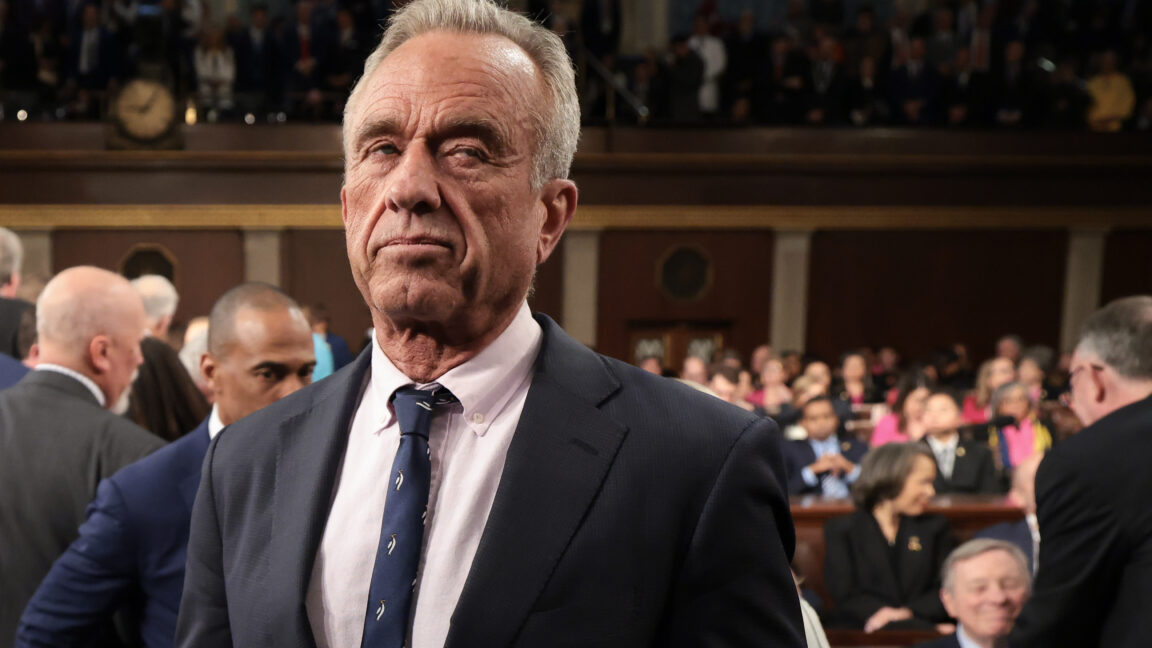
RFK Jr. rewrites CDC panel's charter, opening door to anti-vaccine quacks

1 Share

As expected, anti-vaccine Health Secretary Robert F. Kennedy Jr. has significantly rewritten the charter for a federal vaccine advisory panel. The edits give him more power to appoint his like-minded allies as federal advisors, shift the panel's focus to alleged vaccine injuries and risks, and welcome fringe groups and anti-vaccine organizations to the Centers for Disease Control and Prevention.

On Monday, a notice in the Federal Register indicated Kennedy renewed the charter for the CDC's Advisory Committee on Immunization Practices (ACIP), which is done every two years, with the last term having ended April 1. But instead of the usual humdrum renewal process, the notice on Monday indicated big changes were coming to the defining document of the panel, which heavily influences federal vaccine policy that, in turn, influences state requirements and insurance coverage.

The new charter, published Thursday, reveals new responsibilities that redirect advisors toward topics and terms dear to anti-vaccine activists. For instance, ACIP members will now be responsible for "considering analysis of cumulative effects of vaccines and their constituent components." This wording echoes explicit goals of Kennedy's anti-vaccine allies, who aim to pin complex conditions—such as allergies, autism, and neurodevelopmental conditions—on combinations of vaccinations or common ingredients in those shots, such as aluminum adjuvants. This is a pivot from anti-vaccine activists' earlier attacks that focused on individual vaccines, such as the false, fraudulent claim that the measles vaccine is linked to autism—a claim that has been roundly debunked by dozens of high-quality studies.

The charter now explicitly tasks ACIP with monitoring mRNA vaccines, which have always been in ACIP's purview, but are particularly reviled by Kennedy and those in his sphere. Kennedy once falsely claimed the mRNA COVID-19 vaccine was "the deadliest vaccine ever made."

Concerning changes

Among other changes, ACIP is now charged with "reviewing vaccination schedules by other countries and international organizations. This follows Kennedy's unilateral decision at the beginning of the year to dramatically slash the CDC's childhood vaccine schedule to match the oddly narrow schedule in Denmark, a small country with a relatively homogenous population and universal healthcare.

As for ACIP members themselves, the edited charter vastly broadens the requirements for serving as an advisor. In the previous charter, members needed to be "knowledgeable in the fields of immunization practices and public health." But now they can be knowledgeable in a variety of fields, including one as expansive as "medicine." Despite that wide-ranging category, the new charter identifies other fields, including toxicology, pediatric neurodevelopment, and one listed as "recovery from serious vaccine injuries."

These broadened categories follow a court defeat that temporarily blocked Kennedy's ACIP appointees for lacking relevant expertise to serve on the panel. Kennedy had removed the 17 expert advisors on ACIP last year and replaced them with hand-selected allies that largely share his anti-vaccine views. With the new requirements, Kennedy will likely have little problem installing more advisors of his choosing.

Last, the charter lists 33 non-voting liaisons for ACIP, including standard members like the American Medical Association and the American Academy of Pediatrics. But now it also includes fringe and alarming organizations. Those include: the Association of American Physicians and Surgeons, a politically conservative organization that spreads medical misinformation and conspiracy theories, such as HIV/AIDS denialism; the Independent Medical Alliance (formerly Front Line COVID-19 Critical Care Alliance), which pushed the false COVID-19 treatments hydroxychloroquine and ivermectin amid the pandemic; the Medical Academy of Pediatrics and Special Needs, which supports the false claim that vaccines cause autism; and Physicians for Informed Consent, an anti-vaccine organization.

Read full article

Comments


Read the whole story
Share this story
Delete
Next Page of Stories